Three months in Norway with Tukuuludaa - A Recap Part 3: Our Trip
- Tukuuludaa

- Aug 27, 2025
- 10 min read
We are eternally grateful to everyone who made this trip possible, including (but not limited to): ULU of Norway, the Ulakaia Center, Native Movement, Aleut Community of St. Paul Island, Norwegian Handicraft Institute, TDX Corporation, and the Central Bering Sea Fishermen’s Association. It takes a village to manage a project as big as revitalizing reindeer and fur seal crafting on St. Paul Island, and we are thankful for ours.
Aang Tukuuludaa followers!
In June, we launched our blog series, “Three months in Norway with Tukuuludaa: A Recap.” Our first installment focused on why we decided to go to Norway, and our second installment discussed how we prepared for our trip and used our earnings to support other Unangax̂ creatives. In this third installment, we will discuss the trip, including where we went, what we did, why, and how we made it happen during our three months abroad!
February: Community Visits
(Please note that we use Sámi place names in this article as a sign of respect for our Indigenous Sámi collaborators and friends)
Part 1: Travel and Community Meetings

During February, we traveled across Norway, Sweden, and Finland to learn as much as we could about different kinds of Sámi and Nordic reindeer husbandry, handicraft traditions, and industried.
We started in Gávtjävrrie (Ammarnäs), where we joined an Ume Sámi language class to see how the Ume Sámi community is revitalizing their language and what tools we can take back with us. Later, we got to have a bonfire on Potatisbacken hill and swap northern crafting knowledge.


After our first week in Gávtjävrrie, we got to spend a weekend in Jåhkåmåhkke (Jokkmokk), considered by many to be the antler crafting capital of the world, to learn more about reindeer handicraft. We were so inspired by the many kinds of reindeer crafting projects we saw, which made us excited to return to Alaska and start our own crafting projects with Alaskan reindeer hide and antler.

A big shoutout and thank you/qaĝaalakux̂/Giitu to Juhán Niila for giving us an incredible tour of the Sámi Duodji Association of Sweden building and for purchasing one of our signature Laaqudaa plushies.
After Jåhkåmåhkke, we got to spend some time in Arjepluovve (Arjeplog), home of the world’s largest Sámi silver collection, to learn more about how we can work with materials on our island, like antler, tooth, and ivory in silversmithing and metalurgy.

We are also grateful to local Sámi Ulla-Carina, who showed us around the museum and gave us great information about Indigenous vitality in the region.

After Arjepluovve, we returned to Gávtjävrrie. From Gávtjävrrie, we traveled to Ubmeje (Umeå), where we spent the weekend exploring museums about Swedish and Sámi culture as well as meeting with Sámi leaders at Tráhppie, the regional Sámi culture center.


Then we went to Suarssá (Sorsele), where we got to spend the day at Dalvadis Sami Experience. During our visit, we got to try our hand at reindeer herding and feeding reindeer, which was an invaluable experience as we consider the future of reindeer husbandry in the Pribilof Islands.

At Dalvadis, we were hosted by Inger Anna Eira Andersson, whose ancestors were part of the group of Sámi who came to Alaska to teach reindeer herding to Alaska natives at the turn of the 20th-century. What a nice “reunion.”

From Suarssá, we traveled to Sattajärvi, the location of the Kero Company headquarters and Factory. Visiting Kero has long been a dream of Hannah Atsaq’s, as she has long admired their beak shoes made from entirely vegetable-tanned Scandinavian reindeer leather.
This part of the trip turned out to be one of our highlights, as the Kero Company business model is one we dream of emulating in Alaska – a business where we can both make our own textiles and products from those textiles for sale.

We were so thankful to Emma Kero for taking time out of her busy schedule to give us such a thorough tour of the facilities.

From Sattajärvi, we traveled to Njauddâm (Neiden) to attend a Skolt Sámi crafting night and visit Hannah Atsaq's adopted kooka. Njauddâm is the home of the Ä´vv Skolt Sámi museum. The Skolt Sámi and Unangan, despite their homelands being about 3,500 miles (5,650 km) apart on either side of Russia, share many similarities in language, culture, and handicraft. Both Communities have a strong beading crafting culture and deep connections to the (Russian) Orthodox church. Unangam Tunuu and the Skolt Sámi language (sääʹmǩiõll) have both taken loan words from Russian, and many are the same loaned word. For instance: ‘teacher’ in Unangam Tunuu is “uchiitilax̂”, and in Skolt Sámi is “uʹčteeʹl”; ‘tea’ in Unangam Tunuu is “chaayux̂” and in Skolt Sámi is “čee(i)”; ‘hour’ in Unangam Tunuu is “chasix̂” and in Skolt Sámi is “čiâss”; the adjective “simple/plain” in Unangam Tunuu is “prustuuya-” and in Skolt Sámi is “prååstai.”
Visiting the museum and connecting with Skolt Sámi friends and colleagues was a wonderful way to build solidarity across Arctic Indigenous peoples and learn from each other.


After Njauddâm, we headed to Aanar (Inari), where we spent the day with handicraft students at the Sámi Education Center of Finland. We were especially inspired by the works of Sámi silver smithing students we saw in the halls of the Education Center. We got to dreaming … could the Pribilofs be a new home for Alaska Native silversmiths and metal workers? We have so much scrap metal on our islands – imagine if we could turn it into something beautiful! We hope to continue our Sámi collaborations into the future to develop more making skills we can hone in on and teach in Alaska, especially hope to return to Inari for an extended period of time to study Indigenous silver and metal smithing.


From Inari, we went to Kiruna: our last stop on the tour to visit the design studio of Karin Vasara. Karin Vasara is an award-winning Sámi fur and leather designer who has revolutionized the world of “sámi-inspired” clothing. As she told us when we visited her store, Karin wanted to make clothing inspired by her own Sámi culture that everyone can wear, bringing people into Sámi culture, rather than pushing them out. We hope to do the same at Tukuuludaa, bringing people into Unangan Culture, rather than shaming them away.
We were inspired by all of her creations – especially a jacket she created entirely of reindeer leg skins.

After our visit, we headed to the airport. Once we boarded our plane from Kiruna to Stockholm, that concluded the first part of our trip. Now we were off to Vågå, Norway, for immersive reindeer hide tanning training!
Part Two: Hands-on Training and Earning Reindeer Tanning Certifications
In the second phase of our trip, we completed intensive training with ULU of Norway in reindeer material processing, crafting, and sewing, so we can take the skills back with us for the development of the reindeer crafting industry on St. Paul and in Alaska.
We originally planned to stay with Ulu of Norway for three weeks, but we were enjoying our educational experience so much that we ended up staying for six weeks. During that time, we studied different techniques of reindeer leather making, reindeer fur and hide preparation, and did an emphasis on reindeer-based footwear.


At the end of our time, we earned certifications in traditional reindeer and seal hide tanning methods, which made Garrett Iĝayux̂ the first certified Unangan reindeer tanner, finally becoming an expert on tanning the hides of animals located in the Pribilof Islands for over 100 years.

Part Three: Unexpected trips – Back to Ubmeje and then to Lillehammer
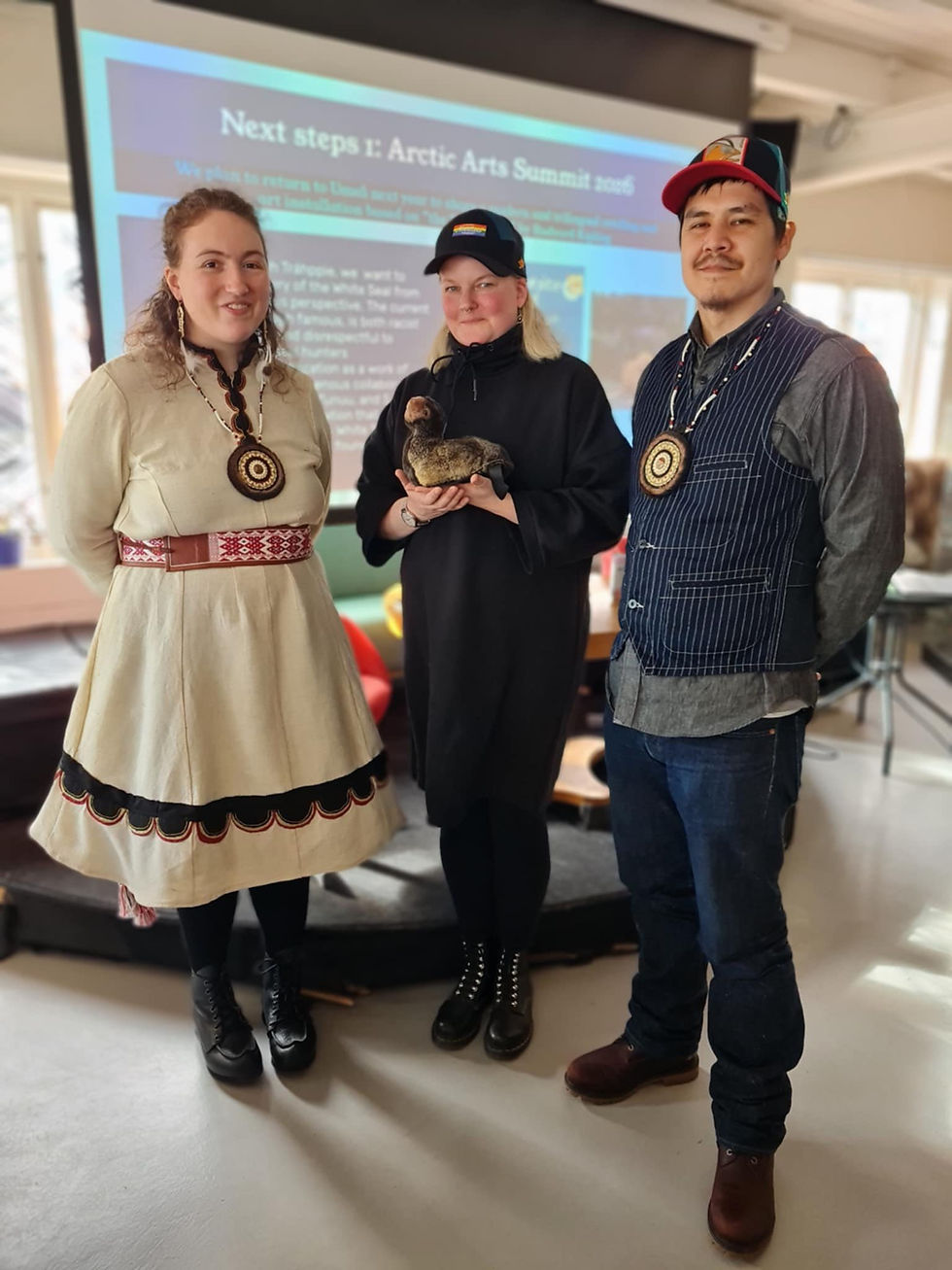
While training in Vågå, we were asked to come back to Ubmeje to give a presentation to Tráhppie Ume Sámi Culture Center, and then also to the Norwegian Handicraft Institute. So, at the end of March, we embarked on a mini-tour back to Ubmeje and then to Lillehammer to speak about our project to revitalize reindeer handicraft in Alaska as well as build Alaska, Sámi, and Nordic connections for larger audiences.


Part Four: Seal Gathering
While training in reindeer tanning, we learned that our co-founder Garrett Iĝayux̂ Pletnikoff had been invited to represent Alaska at the second International Gathering of Seal Hunters and Craftspeople in Northern Norway. The gathering was organized by ULU of Norway in conjunction with the Norwegian National Handicraft Institute and the Nordic Council.
“(Garrett) was invited because of his trailblazing work with revitalization of northern fur seal handicraft in (the Unangax̂) region and for his success in the development of his St. Paul Island-based design studio, Tukuuludaa,” Event organizer and Ulu of Norway co-founder, Sofie Kleppe said.
While initially unsure if he would be able to accept this honor and attend the gathering, thanks to last-minute sponsorship from The Aleut Community of St. Paul Island and Central Bering Sea Fishermen’s Association, Garrett was able to go. Hannah Atsaq came along as his translator.
The Gathering was happening so soon after the end of our reindeer tanning training (two weeks) that it didn’t make sense to go home, so we had a nice, long weekend in Oslo before heading north for the event.
From Oslo, we took a plane to Bodø, a prop plane from Bodø to Brønnøysund, and then two ferries and a private boat to the islands of Hysvær, where the gathering took place. Once there, for seven days, Garrett joined professional and traditional seal hunters, tanners, and crafters from across the Arctic nations as the sole representative of Alaska for knowledge exchanges, collaborative crafting, and discussions of how to build solidarity among seal hunters, tanners, and handicrafters across borders.

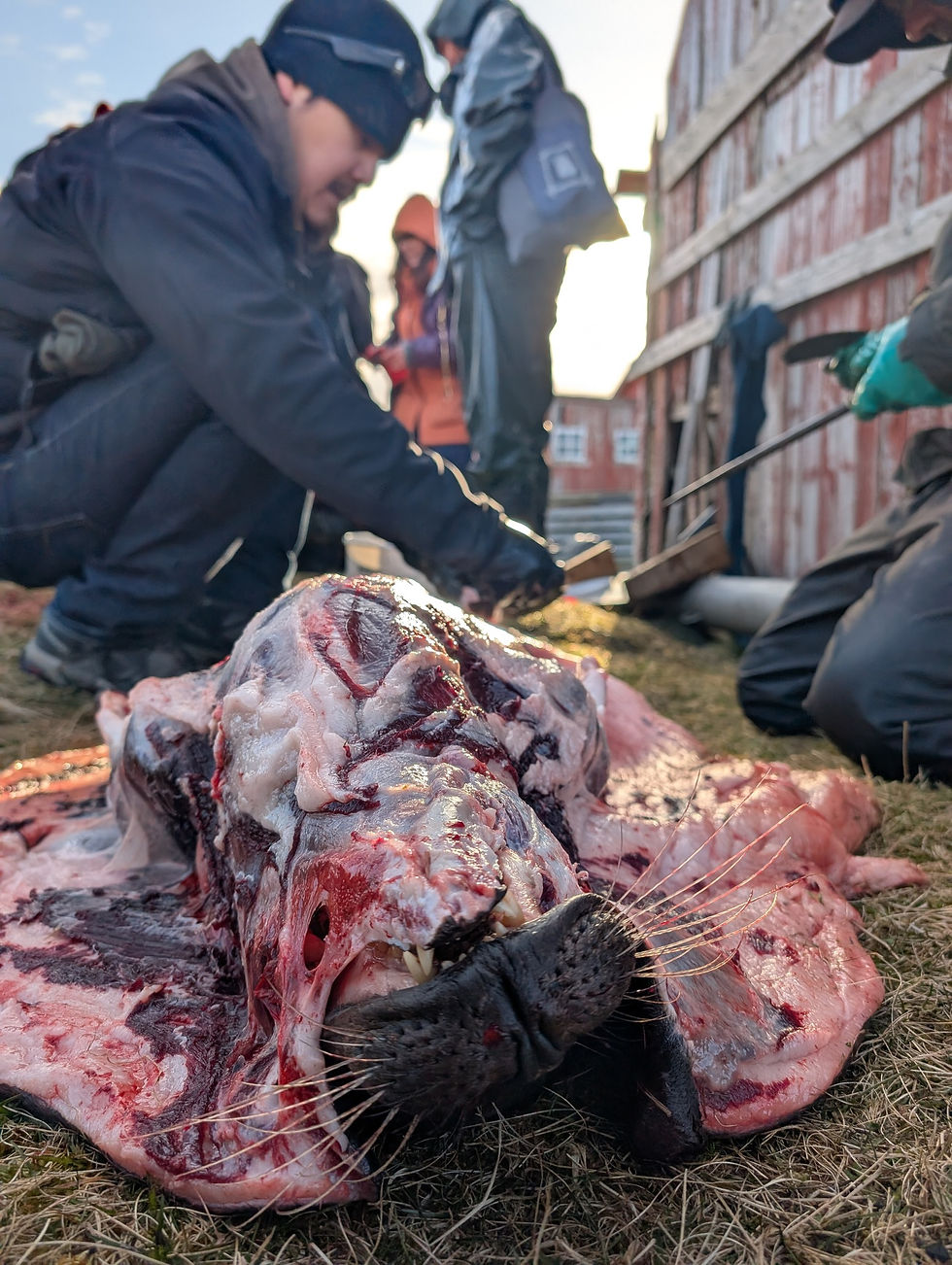
At the gathering, Garrett Iĝayux̂ showed Unangan seal-based knowledges, like the way to butcher a seal and prepare chuqan (seal throats).

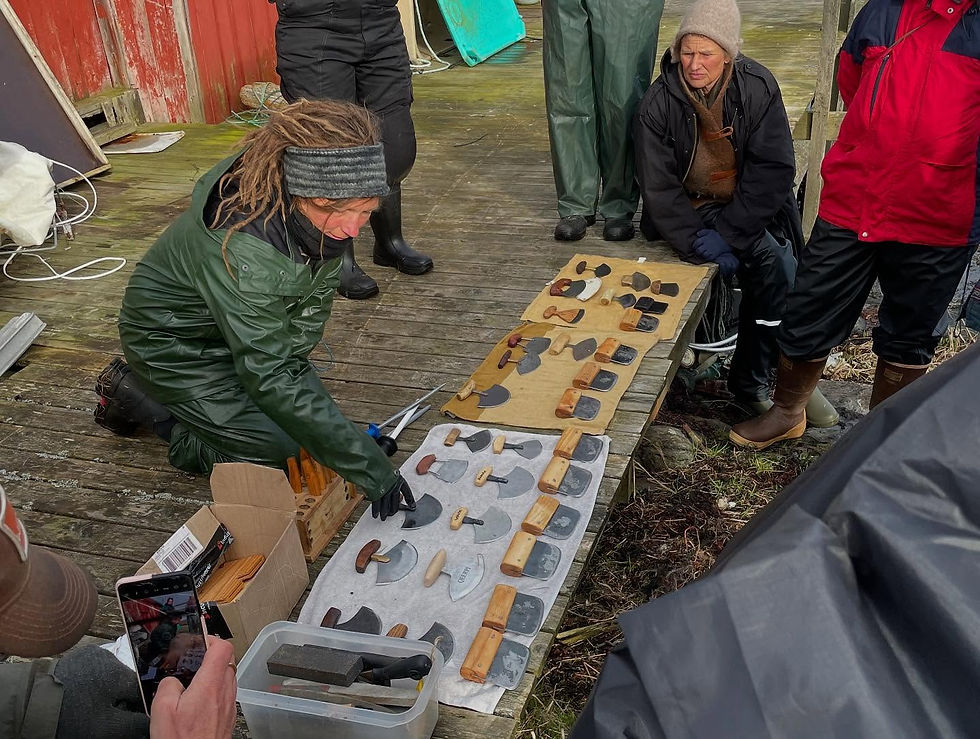
We also got to learn about Inuit Seal technology and tools, such as methods for softening and the many different kinds of Ulu one can use to skin a seal, and how.

In the end, we are so thankful for exchanging knowledge and stories with other seal peoples of the north, and for everything that we learned there.
The conference ended with Garrett Igayux earning his seal (harp, harbor, and fur) tanning certifications

Part Five: Conference in Lillehammer and Meeting the Queen
We were lucky enough to be invited, on our final day abroad, to the Norwegian Håndicraft Institute’s annual gathering — at which the keynote speaker would be none other than Her Majesty, Queen Sonja.
Queen Sonja has been a tireless advocate for artists and handicrafts, both in Norway and worldwide, so we wanted to give her a gift as a token of our appreciation. Garrett Iĝayux̂ made a special seal plushy for the queen, which we customized by leaving a note of gratitude as a tag on the plushy’s neck.

At the meeting, we had the honour to meet Her Majesty, Queen Sonja of Norway, and give her the fur seal plushy, which she called “Lovely” and then carried it around with her for the rest of the day. We also got to discuss with the Queen our work in the Pribilof Islands and how we hope to bring Alaska and Norway closer together through it.
We feel so privileged that a Tukuuludaa seal, made from the pelt of a Pribilof fur seal, will now have a permanent home in Norway’s royal palace.

Part Six: And … we’re back!
After 88 days spent across 3 Nordic countries, with 15+ Sámi and Nordic community and organizational visits and immersions, two hide-tanning certifications earned for each of us in seal and reindeer hide-tanning, one international gathering of Arctic seal hunters and crafters attended as representatives of Alaska, two speaking arrangements, a profile in the Swedish news, and a meeting with the Queen of Norway, our time to return home came. We are so thankful for everyone we got to meet, learn from, and share knowledge with during our time in Sápmi and Scandinavia. We’ll be back soon!